 2Q Solutions
Plenty of factories start small. A few medium machines, simple molds, parts that one person can lift. Then a customer asks for bigger housings, or a new contract needs a heavy pallet, and suddenly the plant is looking at a large injection molding machine. The molds change, the parts change, and the old way of handling them stops working.
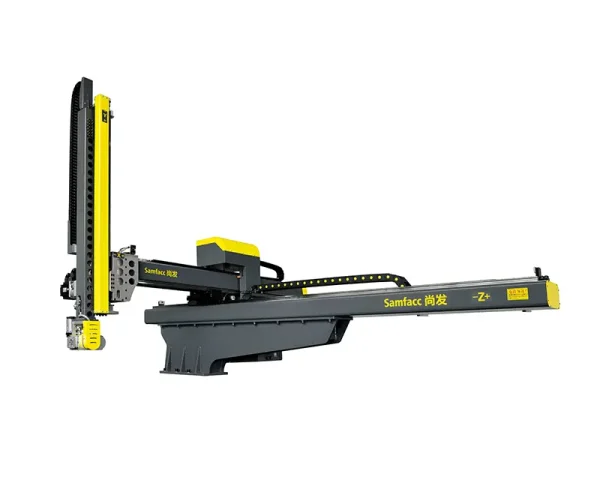
If that is where you are, the robot choice deserves real thought. Below are the questions worth asking, using the published details of the Samfacc Large Range Robot SFN Series as an example of what a specification page can and cannot tell you.
Start with the tonnage
The first question is the simplest. The SFN series page says it is intended for injection molding machines from 900 to 3500 tons. If your machine falls inside that range, the robot is worth a closer look. If you are working with a 200 ton machine, you should be looking at a different series. Robot makers usually divide their ranges by machine size for a reason.
Think about the part, not just the machine
A large machine does not automatically mean a heavy part, but it often does. The page lists applications such as automotive bumpers and trim, washing machine panels, refrigerator housings, air conditioner covers, large pallets and containers, long-strip parts and deep molds with large cavities.
Write down the weight of your heaviest part, its length and how deep the cavity is. The product page does not give payload or stroke figures, so these are numbers to request from the supplier. A robot that suits a bumper is not necessarily right for a deep container, and the gripper has to suit the shape. The manufacturer says customisation of stroke length, grippers and program logic is available, which is useful, but you need to describe your part clearly for it to help.
Check the cycle time against your process
The page states a take-out cycle time of 10 to 15 seconds. Compare that with the molding cycle you actually run. If the robot’s movement fits comfortably inside the time the part spends cooling, it will not hold the machine back. If your process is much faster, ask the supplier whether a quicker configuration exists. Also remember that a stated cycle is a manufacturer’s figure. A demonstration on a similar machine is more convincing than a number on a page.
Look at the workshop itself
Large machines take up space in every direction, including upwards. The manufacturer says the double-stage arm uses a belt-driven double-speed mechanism that raises running speed and reduces the height requirement of the workshop. If your building has a low roof or crane limits, ask for the installed height and compare it with your clearance. Measure before you order, not after the robot arrives.
See how simple it is to operate
Large plants often change molds, and every change means resetting the robot. The page describes a touch screen with 100 sets of mold memory, 18 groups of standard programs and 80 groups of user programs. It says operators can learn the system in as little as half a day, with manuals, videos and PowerPoint process guides provided. The best way to test that claim is to let your own operators try the controls during a demonstration.
Ask about build and support
The manufacturer lists ISO 9001 and CE certification, a 24 to 36 hour test run before shipping, and parts sourced from Japan, Germany, France and Taiwan. It also says that more than 30 technicians provide real-time support. These statements come from the supplier, so ask for the certificates, ask what the warranty covers and ask how quickly help arrives when something stops the line. Downtime on a large machine costs a lot, so support is part of the price you are paying.
A note on safety
A big arm moving over a big mold needs sensible guarding and clear working procedures. The product page does not go into safety arrangements, so raise the topic yourself. Ask what guarding is recommended, how the robot behaves when something unexpected happens, and what training operators and maintenance staff will receive.
Putting it together
Choosing a robot for a heavier line is not complicated, but it does call for precise information. Gather your machine model, mold size, part weight and cycle time, then compare them against what the supplier can offer. Ask for anything the product page leaves out, especially payload, stroke and dimensions, and get answers in writing.
When the match is right, the result is a line that runs at a steady pace, with heavy lifting handled by equipment instead of people.