
 Khizar Seo
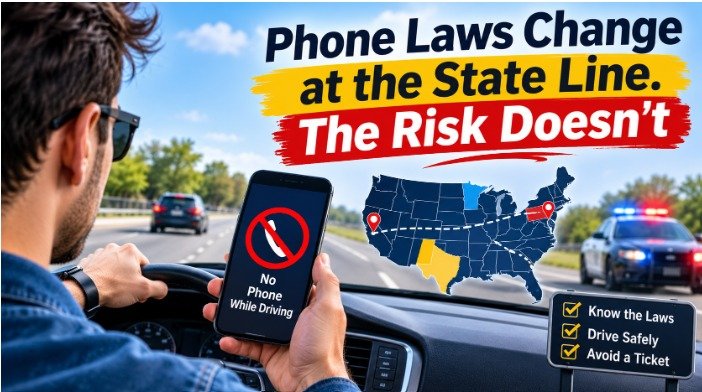
Picture a long road trip. Somewhere in the afternoon you stop at a red light in one state with your phone to your ear, and nothing happens. A few states later you do the same thing and an officer writes you a warning, or a ticket. The car, the light and the call are the same. Only the jurisdiction changed.
That patchwork is why texting and driving laws are worth understanding before a trip, not after a stop. This article explains how the rules are structured, where they differ, why they keep moving, and why obeying the law and driving safely aren’t quite the same thing. It’s a general guide, not legal advice, and the details carry dates because the details change.
There’s No National Phone Rule for Most Drivers
Distracted-driving laws are mostly written by the states. Federal rules reach specific groups. Commercial motor vehicle drivers in interstate commerce, for example, are barred from texting and from using a hand-held phone under FMCSA regulations (49 CFR 392.80 and 392.82). For everyone else, it’s state by state. The Governors Highway Safety Association (GHSA), which tracks these laws, notes that no state bans all cell phone use for all drivers. Two kinds of rule do most of the work: texting bans and hand-held bans.
Texting bans are close to universal. Summaries built on GHSA and NCSL data put the count at 49 states plus D.C., with Montana the holdout lacking an all-driver ban in the most recent tallies I found. Hand-held bans are spottier and still spreading. A May 2024 NCSL map counted 29 states with primary hand-held bans for all drivers. Tallies from late 2025 put the number in the low-to-mid 30s, plus D.C. The exact figure depends on the source and its date, which says something: even the people who count these laws struggle to keep up. The practical takeaway about texting and driving laws is that any number you read is a snapshot.
Three Different Rules Hiding Under One Name
Texting bans
A texting ban prohibits typing or sending messages while driving, and some also cover reading. Most don’t touch hand-held phone calls. Texas is a good example. It bans texting for all drivers statewide but, in the sources I checked, has no statewide hand-held ban for all drivers. Cities and school zones can add their own rules. Verify the current statute before relying on this.
Hand-held bans
A hand-held ban goes further: you can’t hold the phone for any purpose, whether that’s calling, scrolling or snapping a photo. Pennsylvania’s Paul Miller’s Law is a recent example. It took effect June 5, 2025, and it covers hand-held use even while temporarily stopped at a red light or in traffic. Drivers may still make hands-free calls, use GPS and play music, and may contact emergency responders. The first year brought written warnings only. Fines began in June 2026, at $50 plus court costs. Iowa followed a similar arc. Its hands-free law took effect July 1, 2025, with warnings first and penalties starting January 1, 2026, and it carves out emergencies.
Hands-free rules
Hands-free language is where drivers assume the most. These provisions spell out what’s allowed, typically voice calls, navigation and audio, and some states limit voice-to-text or specify how a phone may be mounted. “Hands-free” describes what your hands can do. It doesn’t give you a green light for everything a voice assistant can do.
Same Phone, Different Driver
Who you are matters as much as where you are. GHSA lists 36 states and D.C. that ban all cell phone use, hands-free included, for novice drivers. A teenager on a learner’s permit may face a stricter rule than the adult in the passenger seat, even in the same car. Some states also bar school bus drivers from phone use, and commercial drivers fall under the federal rules above. A single “is it legal?” question really has several answers, depending on license status and vehicle type.
When the Law Moves Under You
New laws usually arrive in stages: signed, effective, a warning period, then fines. Pennsylvania’s roughly year-long gap between its effective date and its first citations is a clean example. A driver who read about the law in 2025 and assumed it was only a warning may have been a step behind by summer 2026. Old summaries of texting and driving laws are a common trap for the same reason, because a page that was accurate when published may have missed an effective date, a warning period’s end, or an amendment.
Road trips make this worse. You can cross several jurisdictions in a day, and each one’s rule applies while you’re in it. Travelers who rely on whatever their home state allows are the ones most likely to be caught out.
How to Check Before You Go
- Start with official sources. Use each state’s DOT, highway safety office or legislature website for the states on your route. GHSA’s state chart works as an index, but confirm the details at the official source.
- Ask the same questions each time. Is it a texting-only ban or a hand-held ban? Does it apply when you’re stopped at a light? What’s allowed hands-free: calls, navigation, voice texting? Are there mounting rules? What do novice-driver rules say? Is there a warning period, and when does it end?
- Note the date on whatever you read. Treat any summary of texting and driving laws, this one included, as a starting point, not the final word.
- When in doubt, use the strictest rule on your route as your own. It’s a simple default that works everywhere.
Legal Isn’t the Same as Safe
The texting and driving laws on your route set a minimum, not a standard of care. A rule that permits hands-free calling doesn’t make a call risk-free. The National Safety Council has long cautioned that hands-free is not risk-free, and the mental load of a conversation doesn’t depend on where your hands are. A rule that lets you dictate a text doesn’t make dictating a text a good idea at 70 miles an hour.
That’s why habits that work in every state are the sturdier foundation for driving safety. They don’t depend on which side of a border you’re on. Set the route before you roll, silence notifications, and keep the phone out of reach. Then the legal question mostly answers itself.
The Short Version
Texting and driving laws differ by state, change on schedules you may not notice, and cover different behaviors under similar names. Check them before you travel, then drive to a higher standard than the law requires. Tools such as My Drive Guardian, which includes text blocking among its features, can help you hold that standard, but they don’t replace knowing the rules where you’re driving.