 Hamza
Hamza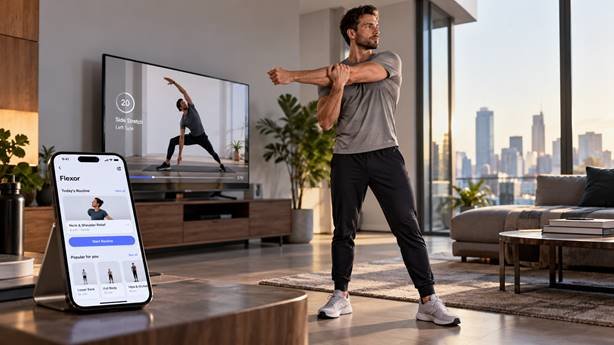
The fitness-app market spent years chasing intensity. Bigger programmes, harder challenges, longer streaks, more data. Flexor arrives with a noticeably quieter proposition: what if the useful fitness product is the one that helps you move for a few minutes when you would otherwise do nothing?
That sounds almost too modest to be interesting. Then you use the app for a while and realise how many small product decisions sit behind that simplicity. Flexor is not only a set of stretches on a phone. It is a connected system for deciding what to do, following it without fuss and making the behaviour easier to repeat.
In a year when almost every wellness product seems eager to bolt on artificial intelligence, Flexor is also a useful example of restraint. AI is present, but it is not the whole identity. The product is still understandable without it.
The first surprise: Flexor does not make you become a mobility expert
A lot of fitness software asks beginners to learn the product’s language before they can benefit from it. Flexor largely works the other way around. You can browse by body area, time, goal or type of session, so the route into the app resembles the way people describe how they feel: shoulders, hips, back, hamstrings; five minutes, ten minutes, before training, after sitting.
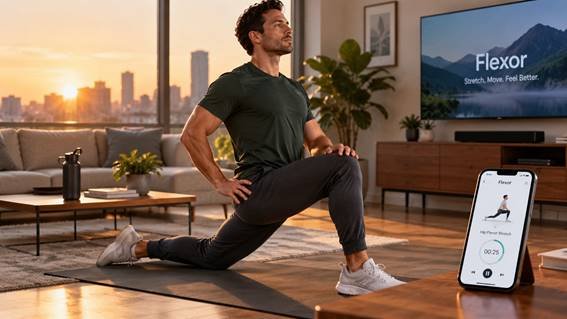
The guided player matters here. Flexor’s video-and-audio routines give each session a beginning, order and endpoint. You are not collecting isolated exercise cards or trying to remember a sequence from social media. Press start and the session progresses with you.
That sounds basic, but basic execution is often what determines whether a wellness app becomes useful. There is a difference between owning information and having an experience that makes acting on that information almost automatic.
The second surprise: the app is more personal without becoming intrusive
Flexor’s personalisation is built from information the user gives it: goals, experience, focus areas, available time and recent sessions. There is no body scan and no claim that the phone can diagnose what is wrong with you. That limitation makes the recommendations easier to interpret for what they are – practical suggestions, not assessments.
The daily recommendation system is probably the least flashy feature and one of the most important. Open the app and there can already be a relevant session waiting. The value is not that a computer has discovered a secret stretch; it is that the app has removed another small decision from a busy day.
Then there is Flexor AI, which handles a different job. Instead of receiving a daily pick, you can describe what you want in your own words and let the app draft a routine from its library. The distinction is smart: recommendations are passive guidance; AI is an on-demand tool.
What makes Flexor feel like a 2026 product
The more revealing parts of Flexor are not necessarily the ones that look best in a screenshot. Its core content is local-first, so routine browsing, plans, custom routines and the guided player continue to work without a live connection once the content is on the device. Completed sessions and basic progress can still be recorded offline. That is the kind of practical engineering users tend to notice only when another app fails to work on a flight or in a bad-signal gym.
The Apple Watch integration follows the same philosophy. Flexor does not pretend the watch should replace the phone. It puts timing and simple routine cues on the wrist, while heavier tasks such as AI generation and detailed browsing remain on the larger device. It is a companion surface, which is exactly what a watch is good at.
Larger-screen playback pushes in the other direction. Stretching is awkward when the demonstration is propped against a bottle on the floor. Casting or mirroring the session to a television makes the movement easier to follow from several feet away. Again, not revolutionary – just unusually attentive to the physical context in which the software is used.
The habit layer is more important than the content layer
Wellness apps often compete by adding more content. Flexor already has a broad catalogue, but its more interesting bet is that content alone is not the bottleneck. The bottleneck is remembering, choosing and returning.
That explains the presence of reminders, plans, custom routines and progress tracking. A person who wants structure can follow a curated sequence. A person who has found a perfect ten-minute reset can save a custom version. A person who simply forgets can schedule a nudge. None of these features is dramatic by itself; together they make the app harder to abandon.
The progress and streaks view is intentionally modest. It shows the sessions you completed and the consistency you are building rather than pretending to score the quality of your body. In a category full of questionable certainty, that is a welcome line to draw.
Why it is worth watching
Flexor is still a young product compared with some established names in stretching and mobility, and that is part of what makes it interesting. The product already spans guided sessions, AI, recommendations, plans, manual customisation, progress, offline use, watch support and television playback, yet the central experience remains easy to explain: choose what you need and follow the routine.
The next stage will be whether Flexor can keep that clarity as the platform grows. Feature-rich wellness apps have a habit of becoming control panels. Right now Flexor mostly avoids that fate because its features orbit a single behaviour rather than asking users to manage the technology for its own sake.
That is why it belongs on a 2026 watch list. Not because stretching suddenly became futuristic, but because Flexor is showing what modern wellness software can look like when the technology supports a very ordinary habit instead of trying to make the habit feel more complicated than it is.
The bigger trend Flexor is tapping into
Wellness software is gradually moving away from the idea that every health behaviour needs to become a major programme. Sleep apps learned that a useful product can be quiet. Meditation apps learned that ten minutes can be a complete experience. Mobility software is reaching a similar point: a short session can be the product, not merely the teaser for something more demanding.
Flexor fits that shift because it treats consistency as the outcome worth designing for. The app does not need a user to identify as a yogi, athlete or flexibility enthusiast. It can be useful to someone whose entire goal is to feel less rigid after work and to remember to move more often. That broadens the audience without watering down the product.
It also gives Flexor room to exist alongside other fitness tools instead of competing with them. A runner can use it around running. A gym user can use it for warm-ups and recovery. A desk worker can use it in the middle of the day. That complementary role may be one of the strongest reasons the app can earn a permanent place on a phone.
What could determine whether Flexor keeps its edge
The challenge for Flexor will be the same challenge facing every fast-moving wellness app: adding capability without burying the behaviour that made the product appealing. AI tools will get more capable, wearable surfaces will evolve and the library will grow. All of that can make the app better, but only if starting a simple five-minute routine remains simple.
So far, the product’s strongest instinct is restraint. AI does not replace browsing. Watch support does not pretend to replace the phone. Progress does not pretend to be a diagnostic score. Offline support preserves the basic experience rather than turning everything into a cloud dependency. If Flexor keeps those boundaries while expanding, it has a credible path from promising newcomer to durable wellness platform.
Where to find Flexor
For readers who want to see the product rather than another promise about it, Flexor is free to start and available through the official stores.